
Myanmar · Culture
Food Offerings to Monasteries in Myanmar: Alms, Meals Before Noon, and Fermented Tea Leaf Salad
What it means to offer food
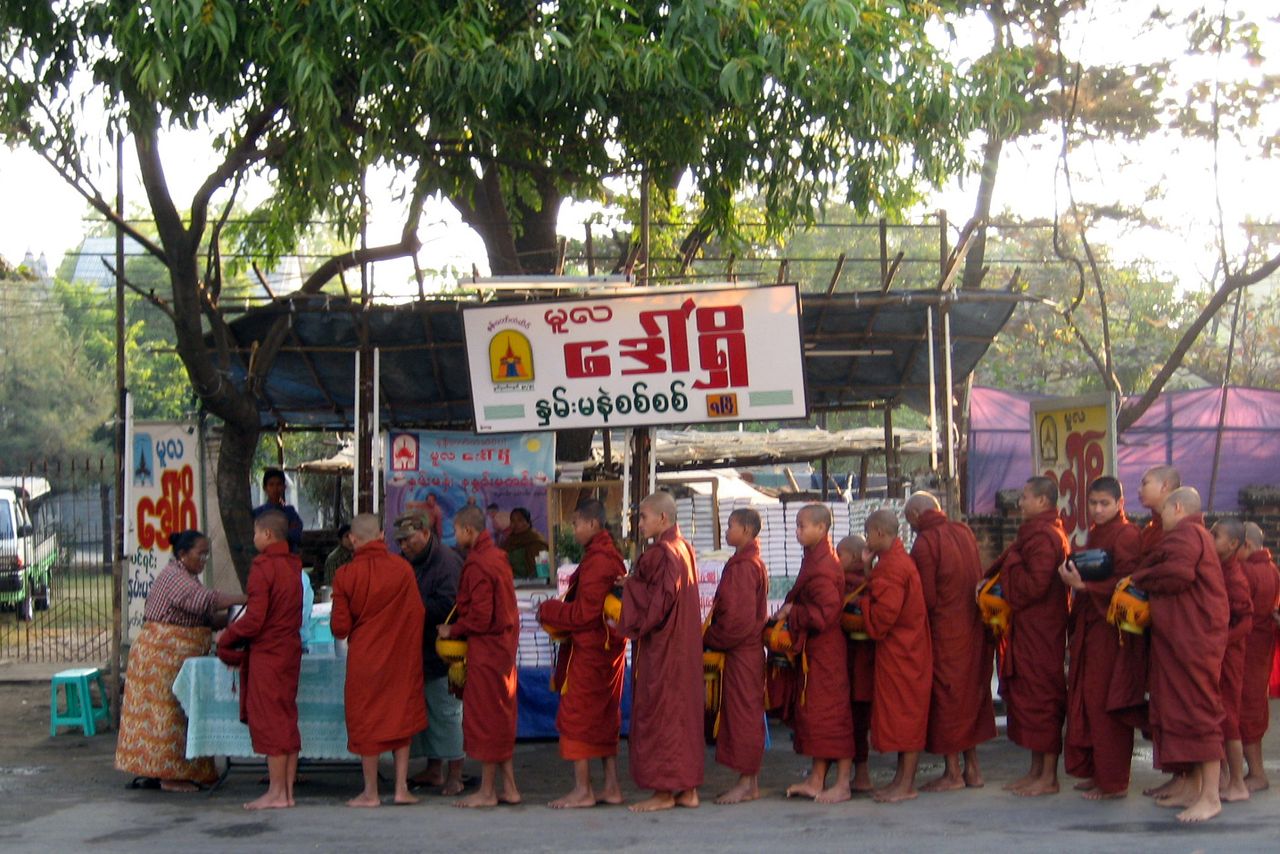
Theravada Buddhism is widely practiced in Myanmar. Theravada monks (bhikkhus) live on food offered by lay people, as the monastic code requires. A Carleton College resource on a Burmese-Buddhist temple in the United States explains that Burmese Buddhists feed monks because the monastic rules make monks dependent on lay people for food. For lay people, offering food is an act of merit; for monks, it is the basis for continuing their practice.
This article summarizes the outline of food offerings to monasteries and the parts of everyday food culture that could be confirmed. Some of the sources are not Myanmar institutions but overseas Buddhist groups, travel guides and an encyclopedia, and the text says so where sources are limited.
Alms rounds and bringing food to the monastery
On an alms round (pindapata in Pali), monks walk from house to house with a bowl and lay people place cooked food in it. According to a Buddhist organization in Malaysia, monks keep silence on the round, the bowl receives only cooked food, and money is not accepted. Uncooked items such as raw rice or dry noodles, and whole fruit, are handed to helpers instead of the bowl. This describes Theravada alms rounds in general, not Myanmar specifically.
Monks walking in line in the early morning is a well-known sight in Myanmar. The Carleton resource adds that monks get food in two ways: the alms round, and, more commonly, lay people bringing food to the monastery. It explains that monks may eat only food directly offered by lay people, so the lay people lift the whole table instead of presenting each small dish. This is the case of one temple, and it may not hold for every monastery.
A meal offering to a monastery is sometimes called sangha dana. A travel guide (Insight Myanmar) says that for such an offering you can sometimes ask for vegetarian food only, but this depends on the monastery’s customs, and if it cannot adapt, it advises accepting the limit.
Eating in the morning, and the rule against eating after noon
Theravada monks eat only between dawn and noon and take no solid food after noon. The Malaysian organization says monks eat within this window and do not go on alms rounds after noon. According to the Carleton resource, the temple kitchen is busiest around 11 a.m. because monks eat before noon.
This rule against eating after noon is generally explained as part of the monastic code (Vinaya). However, the sources I could confirm did not give enough detail on exceptions such as drinks or medicine. Because details are said to be understood differently by tradition and monastery, this article goes no further.
Do monks avoid meat?
This is a commonly misunderstood point. Theravada monks are not required to be vegetarian. The Jivaka Sutta (Majjhima Nikaya 55) in the Pali canon describes when a monk may eat meat and when to avoid it: meat may be eaten if the monk has not seen, heard or suspected that the animal was killed for him; if he has, he avoids it.
The Insight Myanmar guide likewise explains that Theravada monks are not required to be vegetarian and may eat what is offered unless the animal was killed for them. It adds that, although meat is permitted by the monastic code, abstaining from meat is seen among lay people as an admirable virtue, and it says vegetarian monks are treated with particular care.
So food in Myanmar monasteries cannot be treated as the same as shojin ryori or vegetarian food. Japanese shojin ryori leaves out meat and fish in the temple kitchen as a principle, whereas food offerings to monks in Myanmar are not a system limited to vegetarian content. This is not about which is better; they are different food cultures with different origins and ideas.
Lay vegetarianism as a voluntary practice
Do people eat meat, then? The Insight Myanmar guide says vegetarianism is not mainstream in Myanmar but is respected. Shan cuisine has relatively many vegetarian options, but dishes may be cooked in the same pots as meat, so people who want to avoid meat strictly should check in advance.
General Buddhist references note that some lay believers give up meat, alcohol or smoking during the rains retreat (Vassa, about three months). The Insight Myanmar guide also says some people take vows to abstain from meat at Waso, the start of Vassa. These are voluntary practices rooted in personal faith, and the degree varies. This research could not confirm statistics on how many people in Myanmar practice them.
The same guide also reports that King Alaungpaya banned the slaughter of cattle and King Mindon issued a similar order. Because the source is a travel guide, this is kept at “is said to be” level.
Lahpet thoke, the fermented tea leaf salad
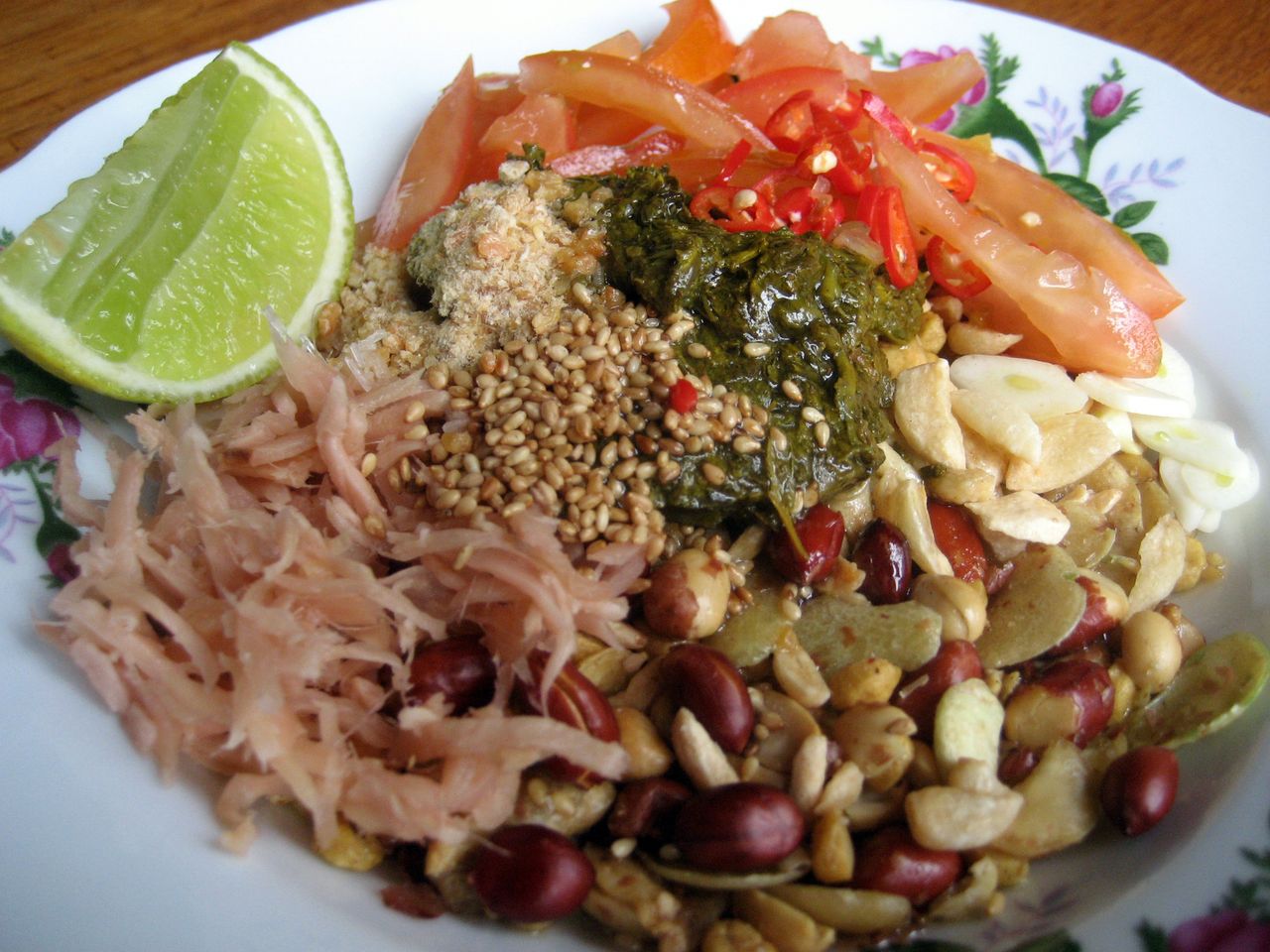
One of Myanmar’s best-known foods is lahpet, fermented tea leaves, and the dressed salad made from it, lahpet thoke. Lahpet means “fermented or pickled tea” in Burmese. According to Wikipedia, the traditional method is to steam young leaves and buds for about five minutes, pack them into bamboo vats or clay pots under weights, and let naturally occurring lactic acid bacteria ferment them for roughly three to four months. The leaves are then washed and massaged and flavored with garlic, chili, salt, lemon juice and peanut oil. The northern Shan State area around Namhsan is among the production areas named.
Lahpet is also known as a symbol of hospitality. The same source says it is served to guests, and that before the colonial era it was exchanged as a peace offering between kingdoms after a dispute was settled. It also says that as Theravada practice became more austere, pickled tea replaced alcohol at public ceremonies. Mandalay-style lahpet is said to be served at novitiation (shinbyu) ceremonies, weddings and meals offered to monks, which suggests a link between food offerings to monasteries and tea-leaf food culture.
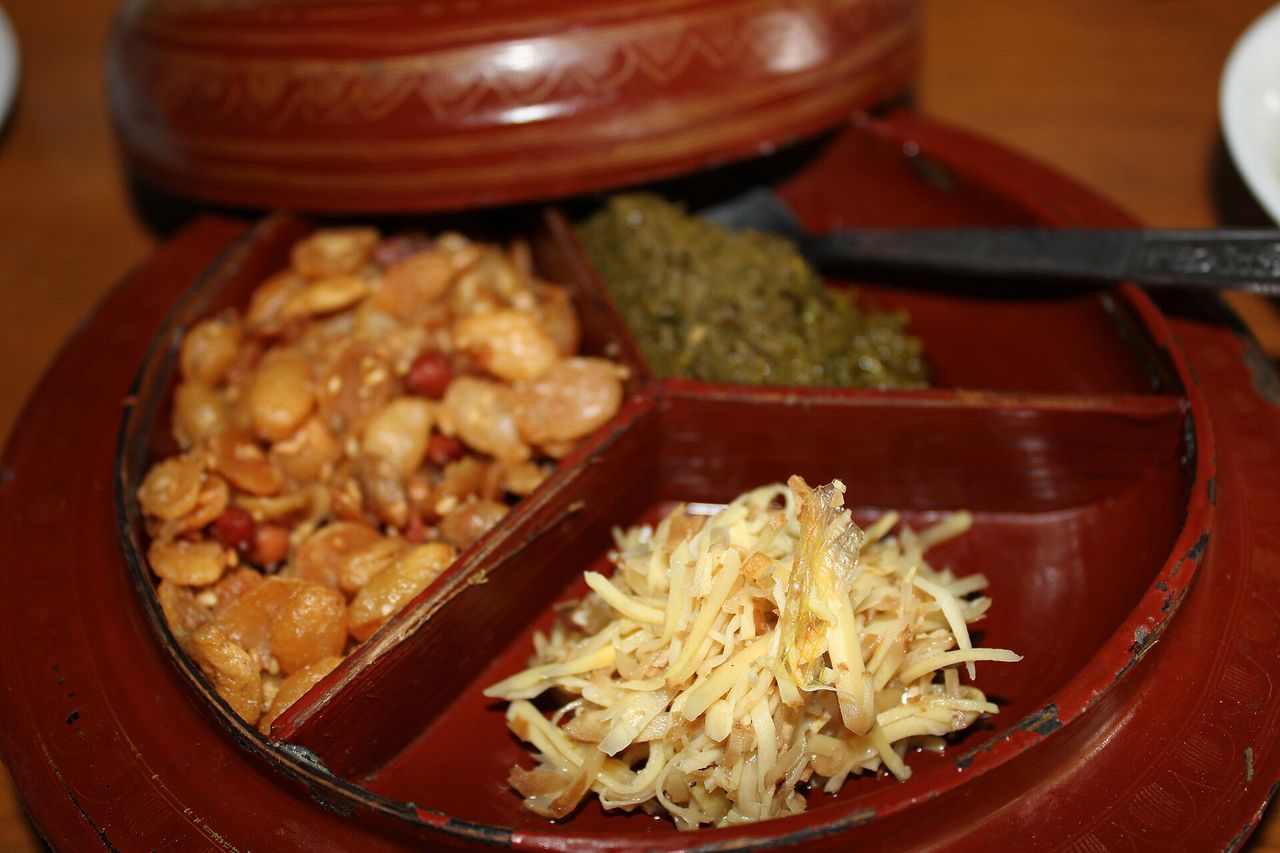
The ingredients of lahpet thoke vary by region and household. The source describes a Mandalay style served in a lacquer dish with compartments holding tea leaves, fried garlic, chickpeas, lablab beans, peas, toasted sesame, peanuts, dried shrimp, pickled ginger and fried coconut. The Yangon style adds tomato, green chili and shredded cabbage and is dressed with fish sauce, sesame oil and lime juice. Some versions thus include dried shrimp or fish sauce and are not necessarily vegetarian. If you want to avoid animal products, check the ingredients.

Dishes made with beans
As noted, chickpeas, lablab beans and other legumes appear in lahpet thoke. Myanmar also has a kind of “tofu” made from beans. Wikipedia’s entry on Burmese tofu says it is made not from soybeans but from chickpea flour or ground yellow split peas, cooked with water until set, and sometimes colored yellow with turmeric. It is said to come from the Shan people and China’s Yunnan, and the entry says it is not known whether chickpea tofu originated in Shan State or southern China.
It is eaten in several ways: fried (to hpu gyaw), as a salad (to hpu thouk, dressed with peanut oil, soy sauce, vinegar, chili, garlic, peanuts, fried onion and coriander), or simmered with tomato and fish sauce in a curry-style dish. Some versions use fish sauce, so they are not always vegetarian. The Insight Myanmar guide says chickpea tofu, popular in Shan State, is a handy protein option for vegetarians.
Bean dishes probably vary by region and cooking method, but this research did not find reliable sources covering home cooking or regional bean dishes in detail, so the article stops here.

For visitors
- When visiting a monastery or joining a food offering, follow local guidance and the monastery’s instructions about timing (meals finish by noon) and etiquette such as photography.
- If you want vegetarian food, say so specifically and in advance, in Burmese if possible. The Insight Myanmar guide recommends asking ahead at monasteries and meditation centers, though responses differ by monastery.
- Even dishes that look mostly vegetable can contain fish sauce or dried shrimp, or be cooked in pots shared with meat, so check ingredients and cooking if you need to avoid them strictly.
- Rather than ranking vegetarian against meat-eating food, or one religion’s or culture’s food against another’s, look at how people in the place offer and share food.
Food offerings in Myanmar are not a system aimed at vegetarianism but a custom of mutual support between monks and lay people. People’s own eating varies too: some eat meat, some abstain for set periods, and some choose vegetarian food every day. What is described here is an outline based on the sources I could confirm, and much differs by region, monastery and person.
Cover image: Offering food to monks on their alms round in Mandalay, Myanmar. Photo: Wagaung / CC BY-SA 3.0 / Wikimedia Commons
