
Hong Kong · Food
Hong Kong’s Zhai and Su Food Culture: Temple Vegetarian Meals and How to Read the Signs
Buddhism in Hong Kong and food called zhai
Vegetarian eating in Hong Kong includes both the meals served at Buddhist temples and the vegetarian dishes found in ordinary restaurants. The temple cooking is called zhai cai (齋菜) in Chinese-speaking regions. The Hong Kong Government’s yearbook (2015 edition) puts the number of Buddhists in Hong Kong at about one million and the number of Buddhist temples and centers at more than 400. It names the Buddha’s Birthday, on the eighth day of the fourth lunar month, as the main Buddhist festival, a public holiday on which followers visit temples. These figures are from around the 2015 edition and may have changed.
This article sticks to facts that could be confirmed from official websites and other sources. It does not recommend or rank any restaurant. It does not treat Buddhist temple vegetarian cooking as the same thing as modern veganism, and it does not argue that vegetarian eating is better or worse than eating meat, or that any religion or culture is better than another. For the Japanese side of this comparison, see Shojin Ryori vs. Veganism.
The vegetarian hall at Po Lin Monastery
Po Lin Monastery stands at Ngong Ping on Lantau Island and is known for the Tian Tan Buddha (the Big Buddha). Its official website has a page on the vegetarian kitchen (zhai chu, or zhai tang), which says the following.
- The vegetarian hall serves the monastery’s su zhai (vegetarian meals).
- The menu uses fresh, seasonal ingredients each day and changes with the time of year. It broadly consists of soup, fried dishes, vegetable dishes and rice.
- To reduce waste, the amount of food is set according to the number of people at each table.
- It is on the left side of the Main Shrine Hall (as you face the hall).
- It is open from 11:30 a.m. to 4:30 p.m., the same hours given in the official visitor information.
- Groups should call the number listed on the official page.
- Next to the hall is a snack counter. According to the official page, it sells more than ten kinds of snacks, such as pastries, noodles and savory items, and the tofu pudding is made fresh every day at Ngong Ping.
The official visitor information lists the monastery as open from 9 a.m. to 6 p.m. and the Tian Tan Buddha from 10 a.m. to 5:30 p.m. These are the hours at the time of checking and may change. The official pages we checked say nothing about how meal tickets work or what they cost. Some third-party blogs list prices, but they are undated and could not be verified, so they are not repeated here. Please check the monastery’s official site or on-site notices before visiting.
What a temple kitchen uses in its ingredients and seasonings is decided by the temple. Some third-party travel articles suggest that certain desserts may contain animal fat, but we could not find an official basis for this, so we do not state it as fact. If you want to avoid animal-derived ingredients strictly, it is best to ask on the spot.

The 1st and 15th of the lunar month, and Buddha’s Birthday
Some Chinese-speaking Buddhists are said to eat vegetarian on the 1st and 15th of each lunar month (chu yi and shi wu). English Wikipedia also notes that some Buddhists eat vegetarian on those days, and on Lunar New Year’s Eve and certain saints’ or ancestors’ days. However, we found no statistics or official material showing how widely this is observed in Hong Kong. It is safest to assume it varies by region, family and individual.
Buddha’s Birthday (the eighth day of the fourth lunar month) is a public holiday in Hong Kong. On when it became one, Time Out says 1999 and another source suggests around 1997 to 1998. Because sources differ, we say only that it became a holiday in the late 1990s. According to the Hong Kong Tourism Board’s Discover Hong Kong site, Po Lin Monastery holds a Buddha bathing ceremony each year from the 2nd to the 8th of the fourth lunar month, and visitors can take part in the Main Shrine Hall. Time Out lists Po Lin and Chi Lin Nunnery among places where the bathing ritual takes place, and says some people eat vegetarian meals that day.
The official materials we found did not say exactly what vegetarian dishes are served at Hong Kong temples on the 1st, the 15th or Buddha’s Birthday. Festival days can be crowded or run differently, so check the temple’s latest notices if you plan to visit.
How to read zhai and su
The character 齋 (zhai) originally refers also to religious fasting or purification, the restraint practiced to prepare body and mind. From there, it came to be used in terms such as zhai cai and su zhai for temple vegetarian food. The character 素 (su), by contrast, simply means without meat or fish and is used more generally. We could not confirm any public standard that sets out how signs and menus should use zhai versus su.
In the Chinese Buddhist tradition, particularly Mahayana, there is a custom of avoiding the wu hun (五葷, also wu xin, ‘five pungent vegetables’), strong-smelling plants, in addition to meat and fish. Wikipedia says Mahayana monastics in China and elsewhere avoid garlic and four other strong-smelling plants. The exact five differ somewhat by source and tradition. Many explanations list scallion, garlic, chives, rakkyo and onion, but it is safer to read this as how it is often explained rather than a fixed list. The same source also says eggs are traditionally not considered vegetarian.
From this tradition, one might guess that ‘zhai’ food connected to temples means no eggs and no pungent vegetables. In practice, it varies by restaurant. For example, an airline’s article describes the dishes at a temple-affiliated vegetarian restaurant in Hong Kong as containing eggs and dairy but avoiding the five pungent spices. So a sign with the character 齋 does not guarantee that eggs and dairy are absent.
Su versus chun su, and checking labels
When you see 純素 (chun su) in Hong Kong, it is probably often used to mean no animal-derived foods at all, including eggs and dairy. However, we found no unified standard from the Hong Kong government on how chun su should be defined, or on how shops use zhai, su and chun su.
For comparison, Taiwan has a national rule for vegetarian labelling on packaged food. Taiwan’s Ministry of Health and Welfare explains that packaged foods claiming to be vegetarian must carry one of five labels: whole/pure vegetarian (quan su or chun su), egg vegetarian, milk vegetarian, milk-and-egg vegetarian, or plant-based with five pungent vegetables. The rule took effect on July 1, 2009. This applies to packaged food in Taiwan and does not apply to Hong Kong as it is. Still, it shows that ‘vegetarian’ can mean several different things depending on how eggs, dairy and the five pungent vegetables are treated.
For this reason, it can be hard to judge a place from the words on a sign or menu alone. The following may help.
- Decide in advance what you want to avoid: eggs, dairy, or the five pungent vegetables such as scallion and garlic.
- Check the notes on the menu or ask the staff before ordering. Some restaurants are said to mark egg and dairy dishes on the menu.
- Mock-meat dishes are often said to be made from wheat gluten or soy. A dish that looks or sounds like meat does not tell you what is in it, so ask if you need to know.
- If you are concerned about animal-derived seasonings, stock or frying oil, say so as well.

Points for travelers
The starting point for a traveler is to decide what kind of vegetarian eating you need, then check whether it matches the place’s standard. A temple’s vegetarian hall is run by a religious institution, which is different from an ordinary restaurant in its approach. For opening hours, how to use it and busy days, check the temple’s latest official information.
Buddhist temple vegetarian food comes from a faith background and has a different origin from modern veganism or health-motivated vegetarian diets. This article does not say which is better, and it makes no judgment about nutrition or health effects. If you have a medical condition or allergy, follow the advice of a professional and the shop’s own information.
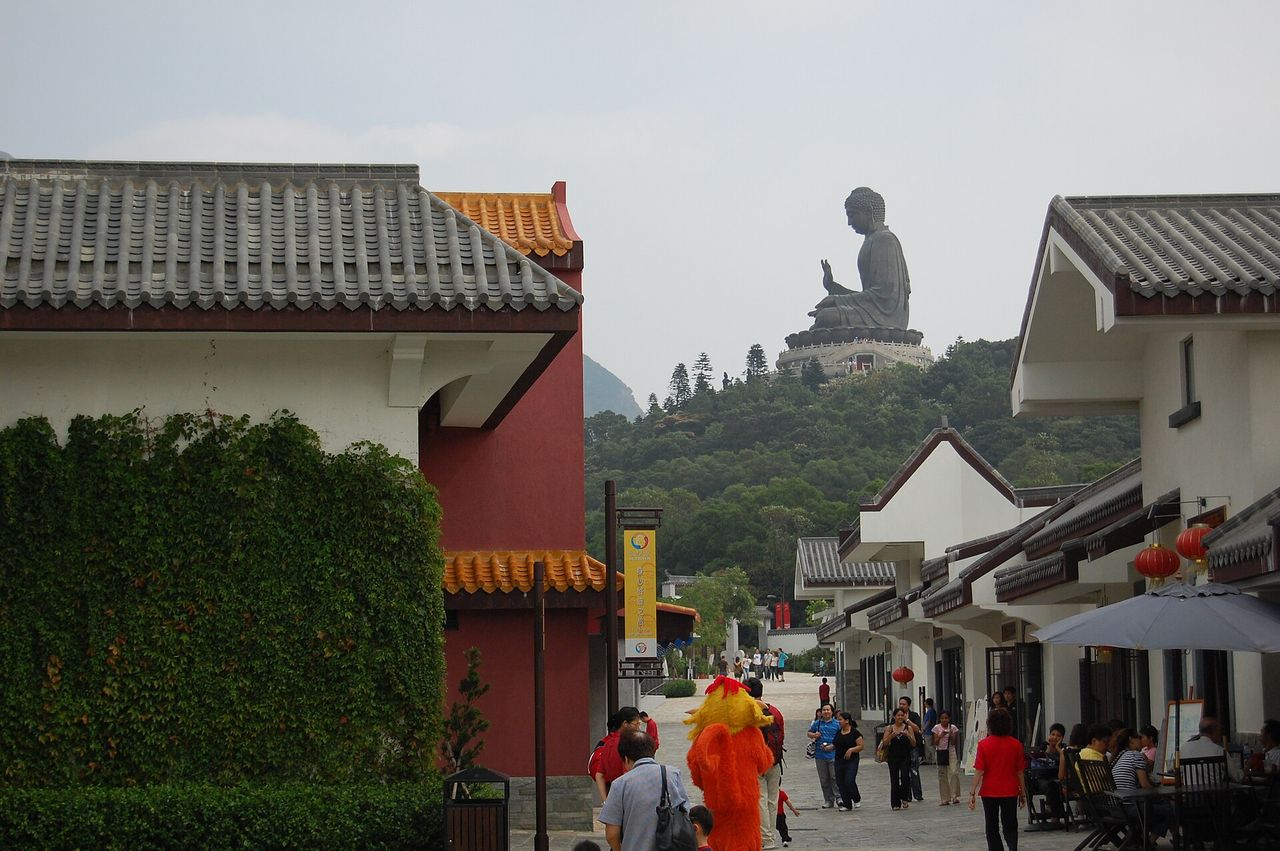
Cover image: The Tian Tan Buddha seen from Ngong Ping Village, Lantau Island, Hong Kong. Photo: edwin11_79 (Flickr) / CC BY 2.0 / Wikimedia Commons

Sources
- Vegetarian kitchen (Po Lin Monastery, in Chinese)
- Visitor information (Po Lin Monastery, in Chinese)
- Religion and Custom (Hong Kong Yearbook 2015, HKSAR Government)
- A guide to celebrating Buddha’s Birthday in Hong Kong (Time Out Hong Kong)
- Po Lin Monastery’s Buddha Bathing Ceremony (Discover Hong Kong)
- Buddhist cuisine (Wikipedia)
- Hong Kong’s best vegetarian restaurants (Cathay Pacific)
- Labelling rules for packaged foods claiming to be vegetarian (Taiwan Ministry of Health and Welfare, in Chinese)