
Taiwan · Food
Taiwan’s Vegetarian Self-Serve Canteens (自助餐): How to Pick Your Dishes and Pay
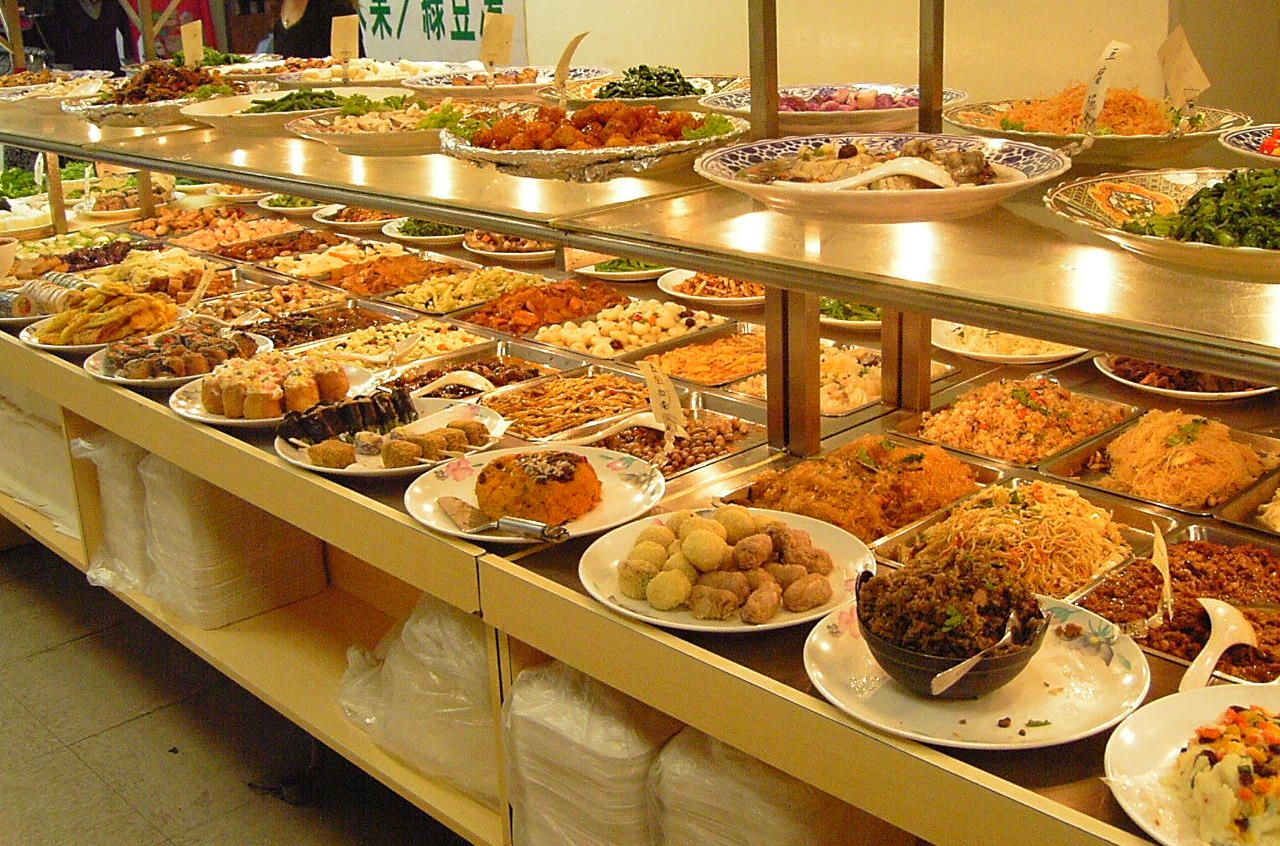
Across Taiwan you will find canteens where you pick up a tray, choose dishes from a counter, and learn the price at the register. The format is called 自助餐 (zìzhùcān, “self-service meal”), and the version without meat or seafood is known as 素食自助餐. Drawing on the sources I could confirm, this article outlines how the format works, how to use it, and what travelers may want to check. It covers the pay-for-what-you-take style; all-you-can-eat restaurants can follow different rules. Details vary from shop to shop.
The vegetarian self-serve style
A 2024 Taipei Times feature describes vegetarian buffets as among the most common meat-free eateries: diners take tofu and vegetable dishes with tongs and pay by weight. A 2024 guide from National Chengchi University’s Office of International Cooperation likewise explains that you choose freely from many dishes and the price is settled at the end, based on the weight of the plate or on what you picked.
Background to the format
On the history of self-service canteens in Taiwan, United Daily News (2025) reports the following. In 1962, after seeing self-service dining on a trip to the United States, the then Taiwan provincial governor Chou Chih-jou ran a trial at Chunghsing New Village, and in June of that year the “Taipei First Quick-and-Simple Restaurant” opened on Guanqian Street in Taipei. Customers read the day’s priced menu, took a tray and tableware, chose dishes along the counter, and paid staff before sitting down. The restaurant closed in February 1964 when its building was rebuilt, but the article says the format spread and can now be found in schools, government offices and neighborhoods. Note that this concerns self-service canteens in general, not only vegetarian ones.
In the material I checked, I could not find a source that pins down when or how the vegetarian version spread. As a clue, a 1991 Taiwan Panorama article said a self-service vegetarian restaurant could be opened for roughly NT$400,000 to 600,000 and that nearly 200 vegetarian restaurants had opened in Taipei in six years. It also stated, as a description of that time, that most were run by members of Yiguandao; this reflects 1991 and should not be read as the situation today.
On religion, Taiwan Panorama’s 2023 article says that the Zhai sect (which a historian it cites traces to the Luo sect) and Yiguandao promoted meatless eating, and that a share of people still avoid meat for religious reasons. The Taipei Times links East Asian vegetarianism to the Mahayana Buddhist idea of non-violence. Taiwan Panorama’s 2021 article, meanwhile, also describes recent efforts to promote plant-based eating for health, environmental and sustainability reasons. The background is not singular, and who runs a canteen differs from shop to shop.

How it usually works (varies by shop)
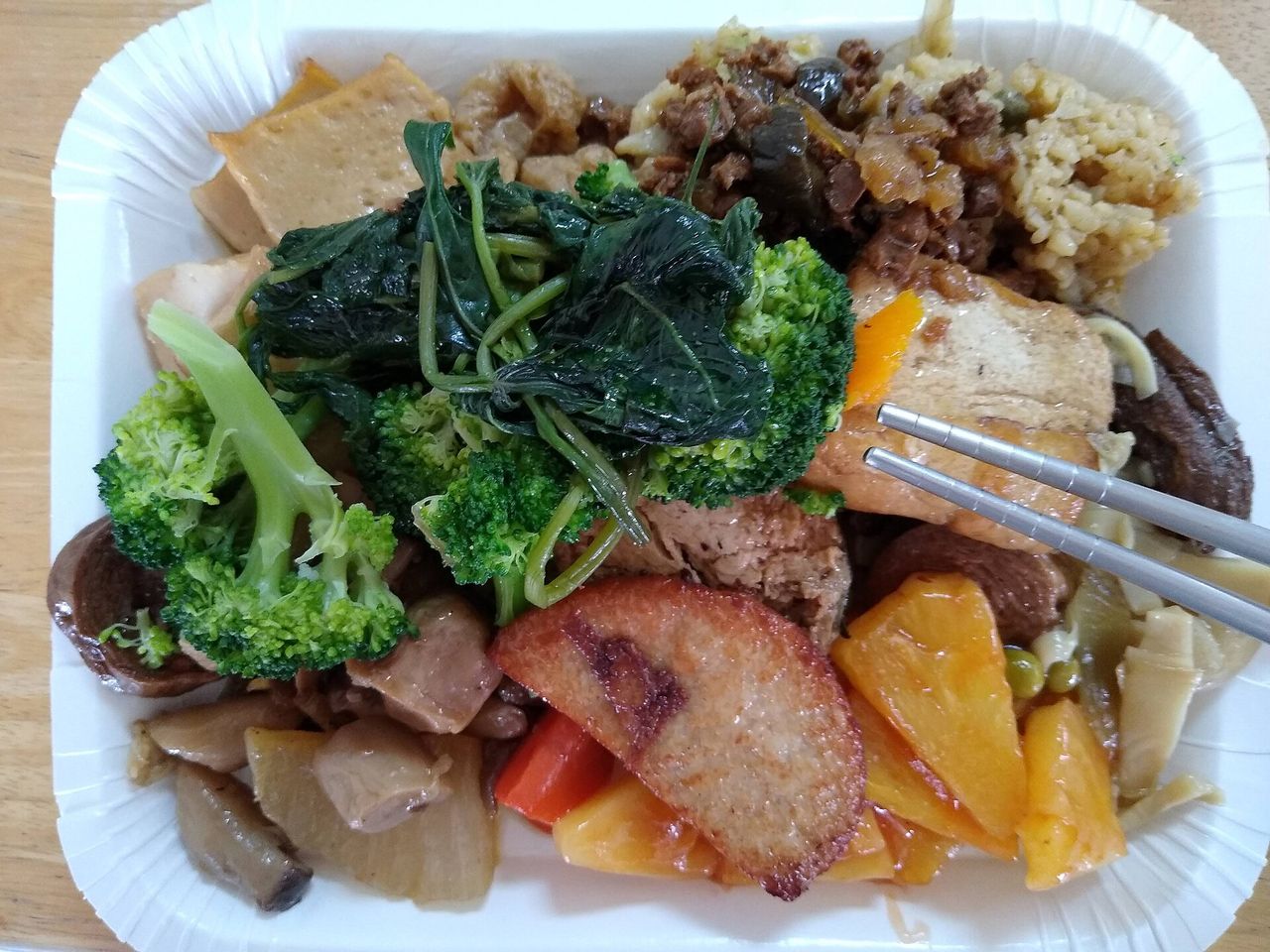
- Pick up a plate or tray and tongs near the entrance.
- Take the dishes you like from the counter. The Taipei Times advises going early, before popular dishes run out or go cold.
- At checkout, some shops weigh the plate; others set the price by the number or look of the items.
- Some shops ask which rice you want (white, five-grain or purple in the Taipei Times example), and some offer soup free. This differs from shop to shop.
Some canteens are connected to temples or Buddhist organizations, but not all of them are self-serve. Taiwan Panorama (2023) notes that Changhua has vegetarian eateries with Buddhist swastika signs, which it takes to show how close local vegetarian culture is to religion. And a 2026 United Daily News travel article described a restaurant inside a Fo Guang Shan temple that priced dishes individually and had separate lunch and evening hours. It is wise to check opening days, hours and payment methods beforehand.

What travelers may want to check
Vegetarian food comes in several kinds. According to the Ministry of Health and Welfare, packaged foods made on or after July 1, 2009 that claim to be vegetarian must carry one of five labels: 全素 (純素), 蛋素, 奶素, 奶蛋素 or 植物五辛素. The wording “素食可” was cited as non-compliant in one case. However, this rule is for packaged food, and dishes on a counter will not necessarily carry such labels. Asking the staff is the surest way to find out.
- Five pungent vegetables (五辛): According to the Taipei Times, onions, chives, garlic and green onions are traditionally avoided, which is why many dishes taste mild. Taiwan Panorama notes that the list differs between sources and that the newer “蔬食” trend does not always avoid them.
- Eggs and dairy: According to the NCCU guide, vegetarian meals often avoid eggs, though there are types that include eggs or dairy.
- Processed items: Mock meats and other processed items may contain egg, dairy or five pungent vegetables depending on the type, even if marked “素”. The existence of several label categories is a good reason to confirm in the shop.
- Phrases to ask: 「這是全素嗎?」 (Is this 全素, plant-only with no five pungent vegetables?), 「有蛋或奶嗎?」 (Does it contain egg or dairy?), 「有五辛嗎?」 (Does it contain the five pungent vegetables?).
For finding places, there are also official materials such as Food X Travel, an English-language vegetarian guide published by the Tourism Administration in December 2022 (72 pages, more than 200 restaurants listed by region). For the basics of the kinds of 素食, see Types of Taiwanese 素食; for the big picture, Taiwanese 素食; and for further reading, our pick from Taiwan Panorama’s vegetarian coverage.
Cover image: The dish counter at a vegetarian self-service buffet in Taipei. Photo: user:takoradee (Own work) / CC BY-SA 3.0 / Wikimedia Commons

Sources
- Taipei vegetarian 101: A beginner’s guide to plant-based dining in the Taiwanese capital (Taipei Times, 2024)
- Being vegetarian in Taiwan: Everything you need to know (National Chengchi University, Office of International Cooperation, 2024)
- 台灣最早的自助餐廳怎麼來的?當年這家餐廳創新竟只活兩年 (United Daily News, 2025)
- Eating Out in Taiwan–Variations on a Popular Theme (Taiwan Panorama, 1991)
- A Vegetarian Paradise: Taiwan’s Meatless Success (Taiwan Panorama, 2023)
- 素得夠味 歡迎蒞臨素食大國! (Taiwan Panorama, Chinese edition, 2023)
- Taiwan’s Vegetarian Awakening: A Gathering Trend (Taiwan Panorama, 2021)
- 素食五標示上路稽查結果公佈 (Ministry of Health and Welfare)
- Food X Travel: The Taiwan Guide to Vegan & Vegetarian Dining (Tourism Administration, 2022)
- 基隆必吃素食餐廳!「佛光山極樂寺滴水坊」 (United Daily News Travel, 2026)