
India · Culture
Vegetarian Culture in India: Religion, Survey Data and Food Labels

How Religion and Food Connect
In India, what people eat is tied to religion, region and family custom. Still, the idea that everyone in India is vegetarian is not accurate. This article sums up what can be confirmed from sources.
According to Pew Research Center’s 2021 report, 46% of Hindus who say religion is very important in their lives are vegetarian, compared with 33% of those who say it is less important. That suggests a link between faith and food practice, though reasons differ from person to person. A 2011 paper by Kazuyoshi Hotta explains that Jainism treats non-violence (ahimsa) as its highest virtue and that the food rules for lay Jains rest on that idea. On Sikhism, Eleanor Nesbitt’s 2015 paper points out that older scriptures and stories do not consistently forbid eating meat, and views on the place of vegetarianism still appear to vary today.
Vegetarianism in Numbers: The 2021 Pew Survey
Pew interviewed 29,999 adults in India face to face between November 2019 and March 2020. According to the results, 39% of respondents called themselves vegetarian. Counting restrictions such as avoiding certain meats or not eating meat on certain days, 81% limit meat in some way.
Self-described vegetarian shares by religion were 92% for Jains, 59% for Sikhs, 44% for Hindus, 25% for Buddhists, 10% for Christians and 8% for Muslims. Among Hindus, the figure varied widely by region: 71% in the North, 61% in the Central region, 57% in the West, 30% in the South, 19% in the Northeast and 18% in the East.
Two cautions apply. First, Pew left the definition of vegetarian to respondents, so the treatment of eggs, fish and so on may differ from person to person; figures from other surveys, with different samples, definitions and methods, cannot simply be compared with these. Second, only 109 Jains were interviewed, and Pew itself says this is too few for a deeper analysis.
The Green Mark and the Brown Mark on Packaging
India requires packaged food to carry a mark showing whether it is vegetarian or non-vegetarian. According to the Food Safety and Standards (Labelling and Display) Regulations, 2020 of the Food Safety and Standards Authority of India (FSSAI), in the compendium version dated 1 July 2022, vegetarian food carries a green filled circle inside a green-outlined square, and non-vegetarian food carries a brown filled triangle inside a brown-outlined square. A page from Tamil Nadu Agricultural University (TNAU) describing the earlier 2011 rules shows both marks as dots (circles). You may still see the phrase brown dot, but in the current regulation text the brown mark is a triangle.
Under the rules, non-vegetarian food includes anything containing part or all of an animal, insects, aquatic animals, eggs or products of animal origin, but not milk, milk products, honey or beeswax. Where egg is the only animal-derived ingredient, a manufacturer may add an optional statement about egg alongside the mark. Mineral water, alcoholic drinks, liquid milk, milk powder and honey, among others, are exempt from the mark.


Regional Differences and Jain Food Thinking
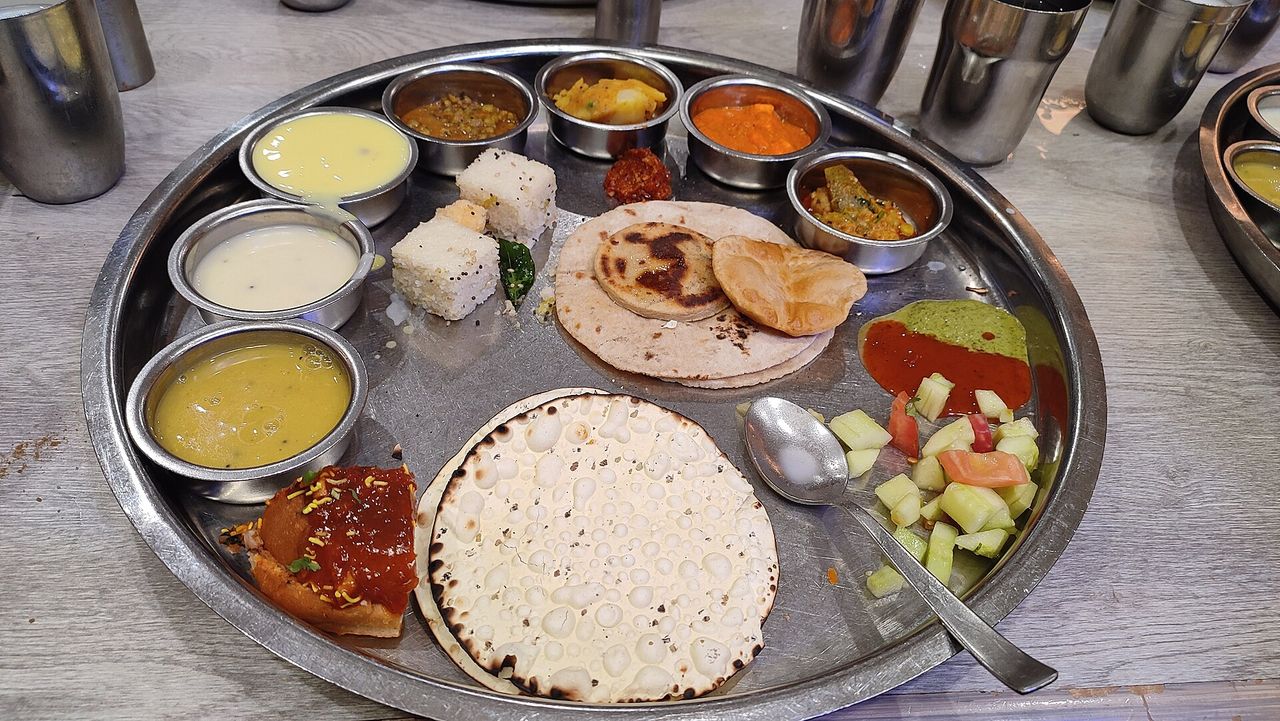
In the Pew figures above, vegetarianism among Hindus was the majority in the North, Central and West regions and a minority in the South, East and Northeast. These are regional groupings, not state-level numbers. For Gandhinagar, the capital of Gujarat, the tourism portal Incredible India says most eateries are vegetarian. The Gujarati thali, a set meal, is described as made up of dal, a yogurt-based curry, seasonal vegetables, flatbread, rice and sweets, with a balance of sweet, spicy and tangy flavours.
In the South, 30% of Hindus in Pew’s data were vegetarian. Yet in Udupi, Karnataka, there is a tradition of vegetarian eateries that appears to have grown out of meals the Krishna temple and its monasteries served to pilgrims. According to a 2022 Outlook India article, at least one long-standing eatery avoids onion and garlic, and people from other communities now use the Udupi name too. Even within one area, the reality is not uniform.
For lay Jains’ basic food rules, Hotta finds that avoiding meat, alcohol, honey, five kinds of plants, eating at night and unfiltered water recur, while noting that the texts fall into several types. In Pew’s survey, 67% of Jains said they do not eat root vegetables such as onion and garlic, compared with 21% of Hindus and 18% of Sikhs. Avoiding root vegetables is not limited to Jains, but the proportions differ. We could not find a source comparing practice between Jain sects or households, so we do not generalize here.
Good to Know for Travelers
- Check the pack for the green circle (vegetarian) or the brown triangle (non-vegetarian).
- In this labelling system, eggs count as non-vegetarian and dairy as vegetarian, so vegetarian does not mean the same as vegan. For the difference, see our article on shojin ryori and veganism.
- Even among vegetarian dishes, whether onion and garlic are used, or whether the food follows Jain teachings, varies by restaurant and by person. Asking before you eat is the surest way.
- Some people avoid meat on certain days or periods (Pew’s 81% includes day-based restrictions). Food customs tied to a religious calendar are also covered in our article on Poya days in Sri Lanka.
- Ideas about food differ greatly by region, religion and individual, so avoid fitting people to a single image and respect what they tell you.
Cover image: A traditional Gujarati thali served on a circular metal platter. Photo: Dvivektx / CC BY 4.0 / Wikimedia Commons

Sources
- Pew Research Center, Religion and Food (2021)
- Pew Research Center, Eight-in-ten Indians limit meat in their diets, and four-in-ten consider themselves vegetarian (2021)
- Pew Research Center, Religion in India: Tolerance and Segregation (2021)
- FSSAI, Food Safety and Standards (Labelling and Display) Regulations, 2020 (Compendium)
- TNAU Agritech Portal, Veg and non-veg symbols
- Incredible India, Gandhinagar
- Outlook India, Udupi: Food, Holy Food!
- Eleanor Nesbitt, Sikhs and vegetarianism (Religions of South Asia, 2015)
- Kazuyoshi Hotta, Food taboos based on religious bioethics (2011, University of Tokyo Repository)