
Laos · Culture
Tak Bat and Sticky Rice in Laos: Morning Alms, the Lao Table and Visitor Etiquette
What is Tak Bat?
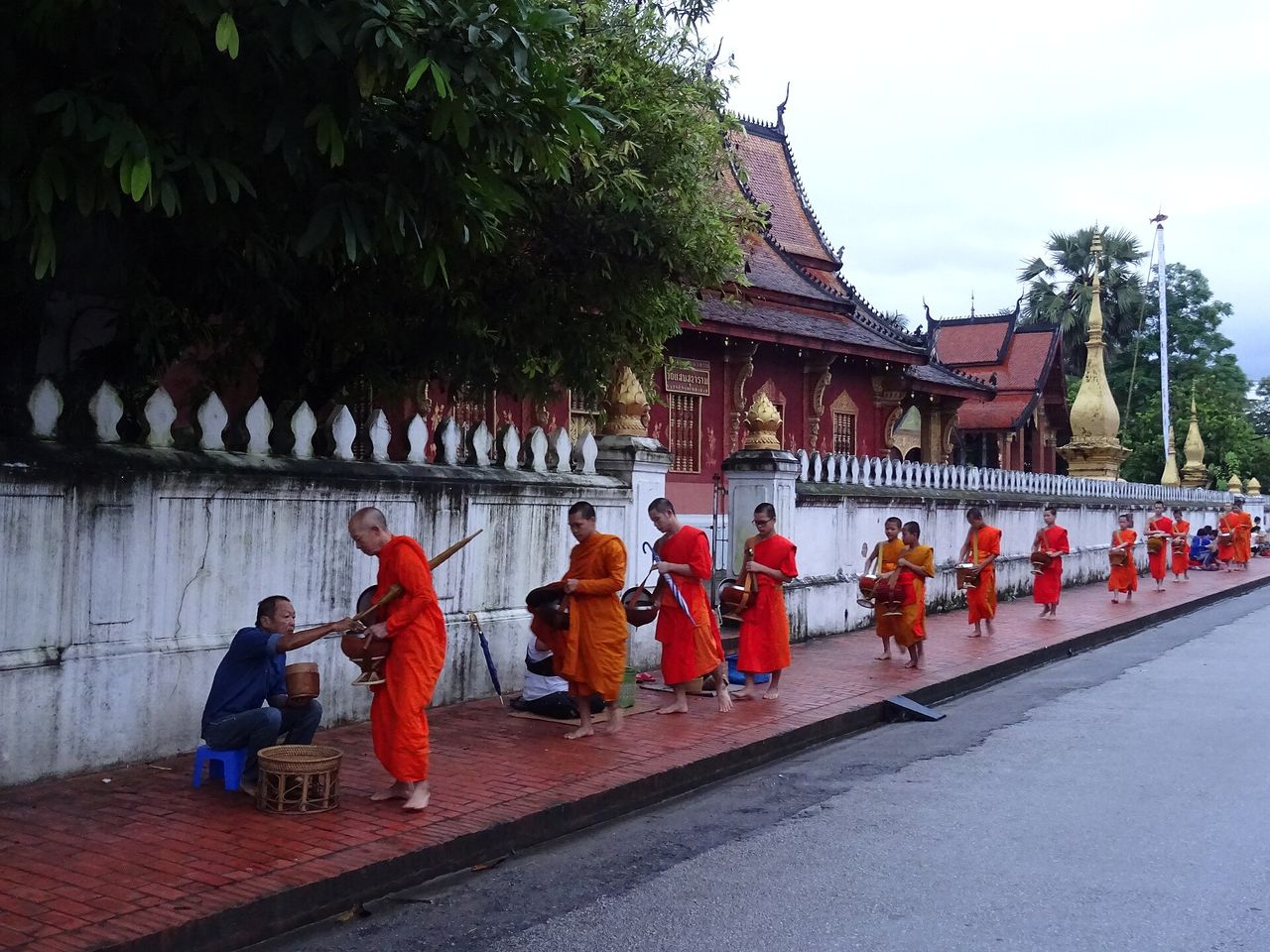
The morning alms round in Laos is called tak bat (also sai bat). Monks leave their temples at dawn and receive food from people waiting by the roadside. The practice is tied to Theravada Buddhist tradition. According to an explainer from Heritage Line, similar alms rounds take place in Laos, Cambodia, Thailand and Myanmar, and the one in Luang Prabang is especially well known. The old town of Luang Prabang was inscribed on the UNESCO World Heritage List in 1995.
Accounts of when the Luang Prabang alms round began vary. Some mention the 14th century and others say more than 600 years, and I could not confirm a firm date. It is safest to say only that it is regarded as a long-standing practice.
The same explainer says monks begin their day around 4 a.m. with chanting and then walk barefoot along routes that differ from temple to temple. Luang Prabang is said to have more than thirty temples. Lay people take off their shoes and kneel on mats, placing food in the bowls of passing monks. The act is presented not as charity in the Western sense but as a way for Buddhists to make merit.
What goes into the bowl: mostly sticky rice
The classic offering is a handful of sticky rice. Per Heritage Line, givers soak the rice overnight and steam it before the ceremony. Sweets and other small items are sometimes added.
The collected rice is shared at breakfast with monks who stayed behind, and the rest is set aside for lunch. Because lunch is the last meal of the day, there is a gap of about 18 hours until the next breakfast, the same source explains. It adds that sticky rice suits this routine because it is dense in calories and digests slowly.

Alms food is not necessarily vegetarian
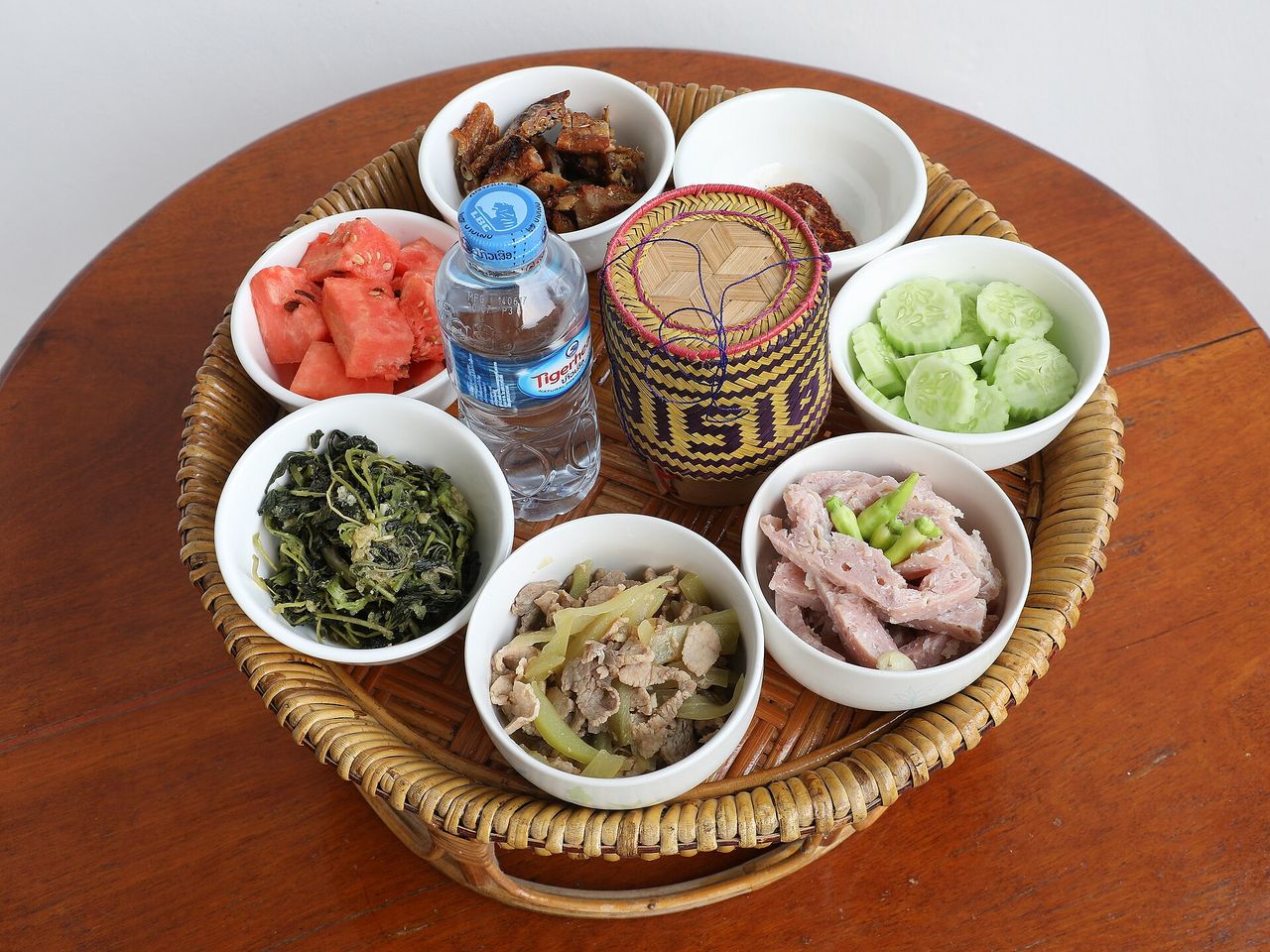
This is a point that is easy to get wrong, so let me be clear. Laos is a Theravada Buddhist country, but it is not a vegetarian country. The starting point is different from Japanese shojin ryori, or from the vegetarian traditions found in some Mahayana regions.
- The Buddha is said to have allowed monks to eat meat under conditions known as the threefold purity: the monk has not seen, heard or suspected that the animal was killed for him. A 2024 article in Tricycle explains that the Buddha rejected a proposal to make the monastic community vegetarian, and that traditions based on the Pali canon generally follow this view.
- A 2002 vegetarian travel article (Vegetarian Journal) says Lao Theravada monks should not kill animals but may eat meat if they did not see or hear the killing, and that because monks depend on daily donations, people can give all kinds of food, including meat.
- An encyclopedic summary likewise states that in Theravada Southeast Asia monks are expected to accept what is offered without choosing. The same source notes that some individual monks choose to avoid meat.
So the alms round is understood not as an act of avoiding meat or fish but as an act of receiving what is given. Travel guides to Luang Prabang often say the bowls mainly hold sticky rice, sweets and fruit, but that reflects what donors choose to give, not a rule requiring vegetarian food. I was also unable to confirm from the sources what is actually placed in the bowls today.
This article does not treat alms-giving, shojin cooking or regional vegetarian traditions as the same thing as modern veganism. Each food tradition has its own background.

Sticky rice (khao niao) and the Lao table
Sticky rice is the staple at the heart of Lao food. In Lao it is called khao niao (also spelled khao niew or khao niaw).
- How it is eaten: the traditional way is to take a pinch of steamed sticky rice by hand, roll or press it, and use it to pick up side dishes or dip into sauces and soups. One source on Lao cuisine says spoons are used for soup and plain rice and chopsticks for noodles (the source itself flags part of this as needing further verification).
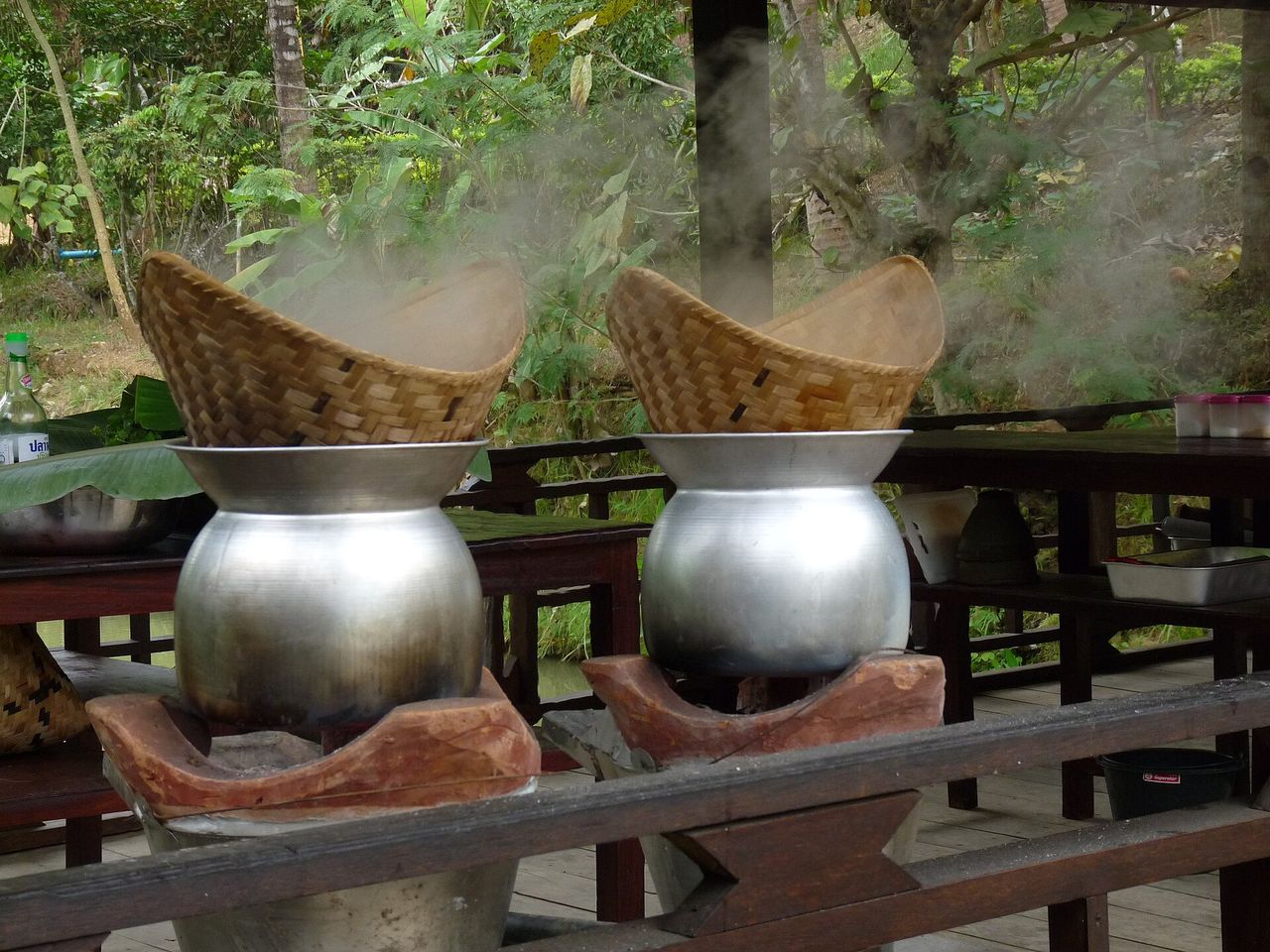
- Cooking tools: the rice is steamed in a cone-shaped woven bamboo basket (huat) set over a pot (maw nung). At a shared meal, one or more baskets are placed in the middle and the lid is closed when people finish, as described.
- A way of describing themselves: Lao people sometimes call themselves luk khao niao, ‘children of sticky rice’, and a scholar is quoted as saying that an affinity for sticky rice is regarded as the essence of being Lao.
- Consumption: Laos is often said to have the highest per-person sticky rice consumption in the world. Smithsonian Magazine gives more than 345 pounds (about 156 kg) a year, and Wikipedia gives 171 kg a year, so the figures differ by source. Neither is an exact statistic, and both are best read as rough indications.
Sticky rice is not exclusively a vegetarian food; it is frequently eaten with meat and fish dishes. Please do not equate sticky rice with vegetarian eating. Lao cooking can also use fish sauce (nam paa), and vegetarian travel articles recommend asking for it to be left out (that article dates from 2002, so check the current situation locally).
Etiquette when watching or taking part
The points below recur across travel blogs and tour company guides. In my research I did not find a single unified set of rules issued by a public authority in Luang Prabang. These are widely shared guidelines, not legal requirements. Please check the latest guidance with your accommodation or a local tourist office.
- Dress: cover shoulders and knees. Take off your shoes if you are giving alms.
- Quiet: the ceremony is conducted in silence. Do not talk loudly, and set your phone to silent.
- Distance and movement: do not get too close to the monks and do not block their path. Do not follow the procession or speak to the monks. Many guides suggest a distance of several meters.
- No touching: do not touch monks or their bowls. Women in particular are advised not to touch monks, and many guides recommend keeping your head lower than the monks’.
- Photos: no flash. Shoot from across the street with a zoom. Do not pose with participants or step in front of monks.
- Timing: start times are said to change with the season; one source says about 5:30 a.m. in summer and 6:30 a.m. in winter. Treat these as rough guides and ask your hotel the day before.
If you take part: preparing the food
Visitors joining as givers are accepted in Luang Prabang, but concerns about commercialization are also widely voiced. The advice attributed to a senior monk in one travel account is to take part only if it has meaning for you. Non-Buddhists are not turned away, but the account suggests avoiding it if it is only for photos (this is a statement in a personal travel article).
- Many guides advise against buying rice from street sellers, because the rice may be old and could upset monks’ stomachs. Asking your accommodation the night before for freshly cooked sticky rice is one suggested alternative.
- Some guides advise against putting money in the bowls or giving heavy items such as bottled water, since monks carry their bowls a long way.
- If you are unsure of the preparation or the meaning, simply watching is also a way of showing respect.
Tourism, and the choice to simply watch
Several travel writers worry that the alms round has become a spectacle for visitors, citing sellers on the road, people crowding in for photos, and people stepping in front of monks. These are observations by individual writers, and in my research I could not find an official survey that measures how widespread this is.
What a visitor can do is remember that for local people this is a daily religious act, not an attraction, and watch quietly from a distance. Watching alone is enough to show respect.
Cover image: The alms-giving ceremony near Vat Sensoukharam in Luang Prabang. Photo: Christophe95 (Own work) / CC BY-SA 4.0 / Wikimedia Commons

Sources
- Tak Bat – Morning Alms in Luang Prabang, Laos (Heritage Line Magazine, 2021)
- A Monk’s Advice on the Tak Bat Almsgiving in Luang Prabang, Laos (Two Can Travel)
- A Responsible Traveller’s Guide to Alms Giving in Luang Prabang (Wanderlust Movement)
- Vegetarian Laos (Vegetarian Journal, 2002)
- Eating Meat in Buddhist Traditions (Tricycle, 2024)
- Buddhist vegetarianism (Wikipedia)
- Lao cuisine (Wikipedia)
- A Taste of Sticky Rice, Laos’ National Dish (Smithsonian Magazine)
- Town of Luang Prabang (UNESCO World Heritage Centre)